

What Is Artificial Intelligence? The Clear Guide to Our Smartest Tool
We’ve all seen the headlines: “AI Writes a Novel!” or “Artificial Intelligence Steals Jobs!” It’s painted as either our savior or our successor. In Silicon Valley, it’s the ultimate genius; in our living rooms, it’s a frustratingly literal chatbot or a weirdly specific ad.
So, what is Artificial Intelligence really? If we strip away the science-fiction tropes and marketing jargon, what remains is not a single, conscious entity, but a profound and rapidly evolving field of computer science. At its heart, AI is the endeavor to create machines that can perform tasks requiring human-like intelligence. This includes learning, reasoning, problem-solving, perception, and language understanding.
Let’s build a clear, grounded understanding of this world-changing technology together.
What is Artificial Intelligence (AI)?
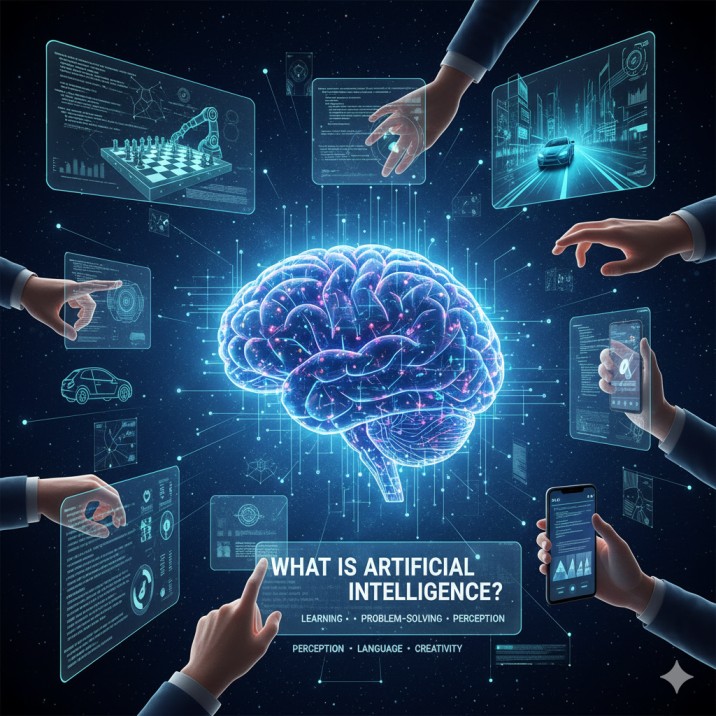
At its core, Artificial Intelligence is the science of creating machines that can perform tasks that normally require human intelligence.
Think of skills like:
- Learning from experience
- Solving problems
- Understanding language
- Recognizing images
- Making predictions
- Taking decisions
Instead of being manually programmed for every situation, an AI system uses data and patterns to think, decide, and improve—just like humans do.
One of the best definitions comes from IBM, which describes AI as systems “designed to think like humans and mimic their actions through data and algorithms.” Modern AI relies heavily on machine learning, neural networks, and deep learning, forming the backbone of today’s smart technologies.
How Modern AI Actually Works
To move past the magic trick, you need to peek behind the curtain. Most of today’s AI breakthroughs are driven by a subset of the field called machine learning (ML). The old way of programming was to give a computer a strict rulebook: “If X, then do Y.” ML flips this script. We give the computer a massive amount of data and a goal, and it learns the rules for itself.
The most powerful flavor of ML right now is deep learning, inspired by the structure of the human brain. It uses artificial neural networks—layers of interconnected “neurons”—to find patterns in data that are too complex for humans to manually code.
Here’s a personal analogy: I once trained a simple image recognition model to distinguish between photos of my two dogs. I didn’t tell it about ear shape or fur color. I fed it hundreds of pictures labeled “Milo” and “Luna.” The neural network slowly, on its own, discovered the intricate patterns of pixels that constituted “Milo-ness.” It wasn’t seeing like I see; it was performing statistical pattern matching at a scale I cannot comprehend. That’s the eerie, brilliant reality of modern AI.
The Two Pillars: Data & Algorithms
- Data: This is the fuel. The quality and quantity of data are paramount. A language model like GPT-4 wasn’t given grammar rules; it was trained on a significant portion of the text available on the internet, absorbing patterns of language, facts, and even biases.
- Algorithms: These are the blueprints for learning. Different algorithms (like neural networks) are chosen based on the task—prediction, classification, generation, etc.
Types of Artificial Intelligence (With Examples)
AI isn’t just one thing. It comes in forms, each with different levels of capability.
| Type of AI | Definition | Examples |
|---|---|---|
| Narrow AI | Designed for one task only | ChatGPT, Siri, Google Translate |
| General AI | AI that thinks like a human | Not yet achieved |
| Reactive Machines | No memory, only reacts | Deep Blue chess computer |
| Limited Memory AI | Learns from past data | Self-driving cars |
| Theory of Mind | Understands emotions | Future research stage |
| Self-aware AI | Has consciousness | Still theoretical |
Right now, Narrow AI is what powers most applications around the world—including the text you’re reading.
Real-World Examples of Artificial Intelligence You Use Daily
You may not realize it, but AI is integrated into your daily routine:
1. Smartphones
Face recognition, predictive text, camera enhancements.
2. Social Media
TikTok’s “For You” page is entirely driven by AI algorithms.
3. Online Shopping
Stores like Amazon use AI to recommend products based on past behavior.
4. Healthcare
AI is now diagnosing diseases faster than human doctors in some areas.
5. Education
AI tutors, plagiarism checkers, and smart grading systems help students learn faster.
6. Content Creation
Tools like ChatGPT, Midjourney, and DALL-E are transforming creative industries.
A Personal Perspective—Why AI Feels Different in 2025
When most people first experience AI—especially conversational AI like ChatGPT—they often describe the same feeling: “It feels like magic.”
I’ve personally seen students who were struggling in school boost their grades just by using AI-powered study tools. I’ve seen business owners grow faster because AI helped them automate tasks they never had time for.
AI doesn’t replace human intelligence—it amplifies it.
But like every technology, it also comes with challenges.
The Benefits of Artificial Intelligence
AI is powerful because it brings five major advantages:
1. Speed
AI analyzes data faster than any human ever could.
2. Accuracy
Medical AI can detect cancers with over 95% accuracy.
3. Automation
AI handles repetitive tasks so humans can focus on creativity and strategy.
4. Cost Savings
Businesses use AI to reduce manual labor and improve efficiency.
5. Personalization
Every app you use today—from Spotify to YouTube—is personalized through AI.
The Challenges of Artificial Intelligence
To be fair, AI is not perfect.
1. Job Displacement
Many fear that AI will replace human jobs.
But research suggests AI will create more jobs than it removes—especially in creative, tech, and analytical fields.
2. Data Privacy
AI systems collect large amounts of data, raising privacy concerns.
3. Bias
If AI is trained on biased data, it can produce biased decisions.
4. Over-reliance on AI
People may start depending too much on AI, reducing critical thinking.
Artificial Intelligence vs. Human Intelligence
| Feature | Artificial Intelligence | Human Intelligence |
|---|---|---|
| Speed | Extremely fast | Slower |
| Creativity | Limited | Boundless |
| Emotions | None | Full emotional intelligence |
| Learning | From data | From experience & emotion |
| Adaptability | Limited | Highly adaptable |
AI is powerful—but it cannot replace the creativity, empathy, and moral judgment of humans.
The Future of Artificial Intelligence (What Experts Predict)
According to research from McKinsey and MIT, AI will continue to grow in:
- Education (personal AI tutors)
- Medicine (early diagnosis & drug discovery)
- Business automation
- Robotics
- Space research
- Cybersecurity
You can expect faster, more personalized AI tools that feel even closer to human thinking.
Should You Learn AI? Absolutely. Here’s Why.
Whether you’re a student, freelancer, business owner, or job seeker—understanding AI gives you a massive advantage.
You can use AI to:
- Improve productivity
- Automate routine work
- Learn faster
- Earn more
- Build stronger skills
- Stay relevant in a competitive world
Learning AI is no longer optional—it’s becoming a basic skill, like using a computer or the internet.
Artificial Intelligence Is Not the Future—It Is the Present
Artificial Intelligence has already changed how we work, live, learn, and interact. It’s powerful, fast, helpful—and still evolving.
Understanding AI helps you stay ahead in a world where technology is shaping every industry.
AI isn’t here to replace us—it’s here to empower us.
If you enjoyed this guide and want more AI, technology, or education-related content:
👉 Leave a comment below
👉 Share this article with your friends
👉 Explore more articles on AI and future technologies
👉 Subscribe to stay updated
Your future is AI-powered—start exploring it today.




Pingback: Is AI Hard to Learn? A Beginner-Friendly Guide to Mastering Artificial Intelligence - NB Academy
Pingback: Top AI Video Generator Tools in 2025 – Create Videos Faster & Smarter - NB Academy
Pingback: Google Creative Fellowship 2026: Complete Guide to Apply, Benefits & Eligibility - NB Academy